
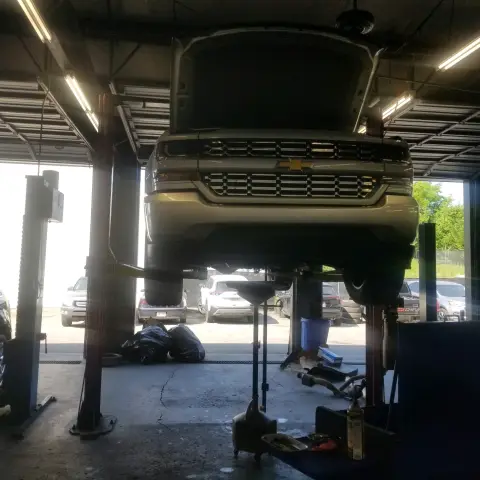
Your exhaust system quietly routes hot, toxic gases from the engine to the back of the vehicle, cleaning and silencing them along the way. Our family-owned shop handles exhaust, muffler and catalytic converter repair in Hermitage, TN for drivers who come to us from Nashville and nearby communities.
We work on exhaust systems in domestic, Asian, European and hybrid vehicles. From a rattling heat shield to a cracked manifold or a failed converter, we inspect the system from the engine back and explain what needs to be repaired.
Signs your exhaust system needs repair
- Loud rumble or roar. A hole in a pipe or muffler lets exhaust escape before it is quieted.
- Ticking at start-up. A cracked exhaust manifold or leaking gasket often ticks loudly until it warms up and expands.
- Rattling underneath. Loose heat shields, broken hangers or a deteriorating converter can rattle over bumps or at idle.
- Rotten egg smell. Often linked to a struggling catalytic converter.
- Exhaust fumes in the cabin. A serious safety concern because of carbon monoxide; get it checked right away.
- Check engine light. Converter efficiency or oxygen sensor codes are common exhaust-related faults.
- Sluggish acceleration. A clogged converter can restrict exhaust flow and choke engine performance.
What our exhaust service can include
- Full exhaust system inspection from manifold to tailpipe
- Exhaust manifold check, repair or rebuild
- Exhaust gasket and flange repair
- Tailpipe inspections and crack and leak repairs
- Muffler replacement
- Catalytic converter inspection and replacement
- Oxygen sensor testing and replacement
- Hanger, clamp and heat shield repair
How exhaust repair works with us
- Request an appointment. Book online or call 615-600-5994. Let us know what you are hearing or smelling and whether the check engine light is on.
- Lift inspection and estimate. We raise the car and check the system for leaks, damage and loose components, and scan for related codes. We explain the findings and provide an estimate before beginning any repair.
- Repair. Once you approve, we repair or replace the damaged sections and confirm there are no leaks.
- Pick-up. We review what was done and clear any related codes after verifying the repair. Payments through Affirm are an option, subject to approval by Affirm.
Why converters fail, and how to protect yours
The exhaust manifold collects gases from the engine’s cylinders. From there, they pass through the catalytic converter, then one or more resonators and mufflers that cancel out noise, and finally exit through the tailpipe. Oxygen sensors before and after the converter let the engine computer fine-tune fuel delivery and monitor emissions.
Catalytic converters rarely fail on their own. More often, an engine problem upstream ruins them. A misfire sends unburned fuel into the converter, where it burns and can overheat and melt the internal honeycomb. An engine that burns oil or leaks coolant can coat the catalyst and reduce its efficiency. That is why we look for the root cause before recommending a new converter; replacing it without fixing the engine problem can lead to the same failure again.
Moisture is the other enemy. Short trips do not get the system hot enough to drive off condensation, so mufflers and pipes can rust from the inside out. A longer drive now and then helps. And if your check engine light starts flashing, ease off and have it looked at promptly; it is often a misfire, and acting quickly can save the converter.
Related services
- Tire Services & Wheel AlignmentFlat repair, rotation, balancing, tire replacement and wheel alignment done in our shop to help your tires wear evenly and your car track straight.
- Suspension, Steering, Shocks & StrutsBouncy ride, clunks over bumps or heavy steering? We inspect and repair shocks, struts, power steering and front-end parts and explain the fix first.
- Cooling System & Radiator RepairOverheating or losing coolant? We pressure test and inspect the radiator, hoses, thermostat and water pump and explain the repair before work begins.
- Battery & Electrical ServiceSlow starts, dim lights or a battery that keeps dying? We test the battery, charging system and starter, find the cause and explain the repair first.
Frequently asked questions
Why did my car suddenly get so loud?
A sudden increase in exhaust noise usually means a hole, a broken pipe, a failed gasket or a muffler that has rusted through. If the roar started overnight, check whether the catalytic converter is missing, since converter theft has been a widespread problem.
Can an exhaust leak be dangerous?
Yes. Exhaust contains carbon monoxide, an odorless gas that can cause headaches, dizziness and worse if it seeps into the cabin. A leak near the front of the system or under the passenger area deserves prompt attention, and you should drive with windows cracked until it is repaired.
What does a catalytic converter do?
It uses precious metal catalysts to convert harmful exhaust gases, such as carbon monoxide, unburned hydrocarbons and nitrogen oxides, into less harmful carbon dioxide, water vapor and nitrogen before they leave the tailpipe.
What causes a rotten egg smell from the exhaust?
A sulfur or rotten egg smell often means the catalytic converter is not processing exhaust gases properly, sometimes because the engine is running too rich. It can also be related to fuel quality. Because the converter may be overheating, have it checked rather than waiting.
Can a bad catalytic converter turn on the check engine light?
Yes. Oxygen sensors before and after the converter measure how well it is working, and if efficiency drops below the expected level, the engine computer sets a code. We confirm whether the converter itself has failed or whether an upstream problem, such as a misfire or faulty sensor, is the real cause.